

Get the total cost chart as well as the detailed comparison table on ETF and fund savings plans from Swiss providers conveniently and for free by email.

Banking News
Cost Comparison of Swiss ETF and Mutual Fund Savings Plans
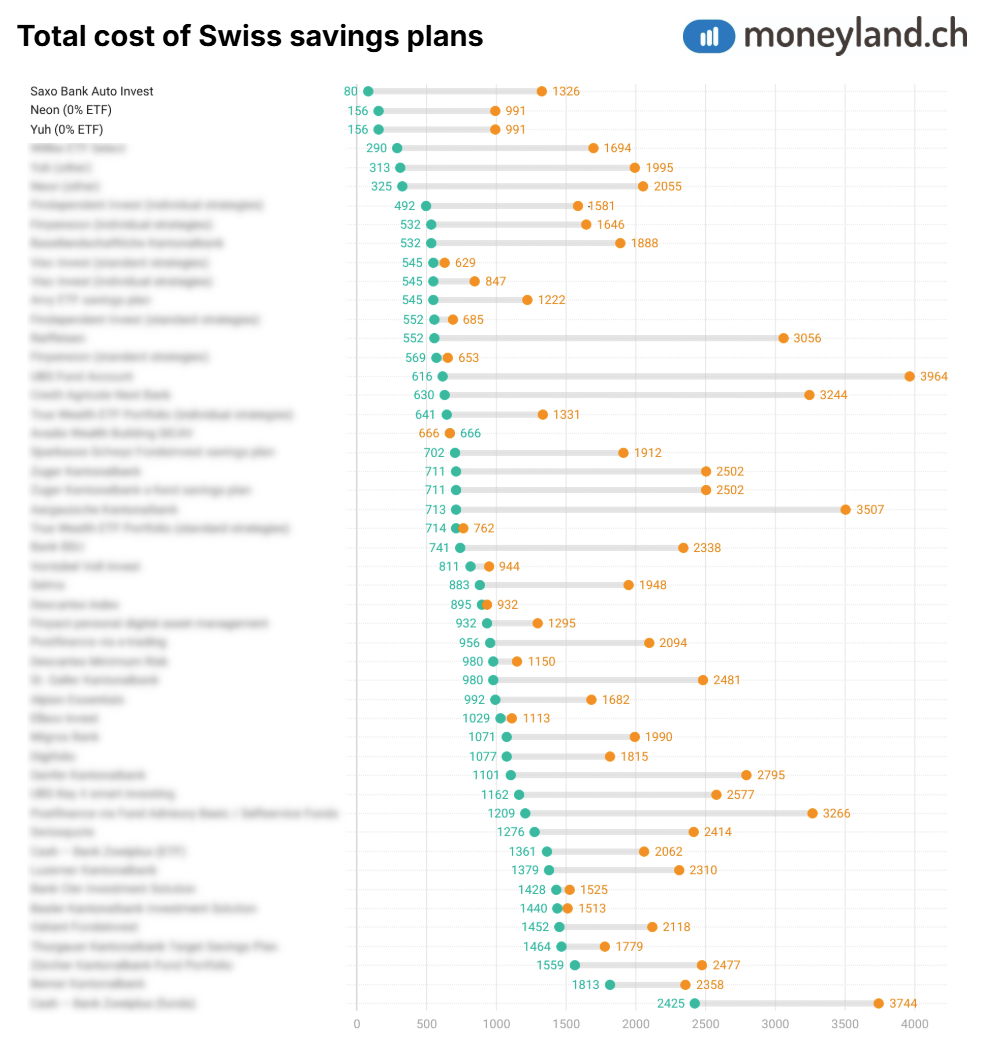
Savings plans are a practical and convenient solution for investing money on a regular basis. But how high are the fees charged by banks? A moneyland.ch cost analysis of 40 Swiss savings plan providers shows that using the total fees across a 10-year saving term range between 80 francs with the cheapest plan and 4000 francs at the most expensive provider.
Setting money aside every month and investing it in an exchange-traded fund (ETF): That process can be done manually, but a savings plan makes it much simpler. The money is automatically invested in one or multiple mutual funds or ETFs. In the past, these savings plans were a niche product. But today, savings plans are offered by numerous Swiss financial services providers.
Online comparison service moneyland.ch analyzed savings plan fees across 40 service providers. The analysis clearly shows that not all savings plans are equal. On the one hand, the selection of funds available varies greatly between banks. “While some service providers only have a handful of funds to choose from, others let you select from over 100 different funds,” explains moneyland.ch personal finance expert Ralf Beyeler.
Banks also differ hugely in terms of the fees you pay. There are two main fees that together make up the total fees: The fees charged by the savings plan provider, and the TER fees charged by the ETFs or mutual funds that you invest through.
A diversified stock portfolio is important
In addition to keeping fees to a minimum, it is also important to use a diversified stock portfolio. “Having a broadly-diversified portfolio helps to minimize concentration risks,” comments Ralf Beyeler. “The easiest way to create a diversified portfolio is to use index funds or passive ETFs that replicate global stock indexes.” The MSCI World and the FTSE All-World are two examples of well-known global stock indexes.
You should be aware of the huge US components in most global stock indexes. Currently, around 73 percent of the MSCI World is made up of US stocks (as per October 30, 2026). Because of that, making additional, targeted investments in stock indexes from other countries or regions can help you further diversify your portfolio.
Important: “Being able to cope with temporary falls in the value of your savings is a prerequisite for investing in the stock market,” comments Ralf Beyeler. Historically, markets have recovered and grown over long terms, which means the risk of loss declines the longer you hold your investments, though it can never be completely ruled out. If security and stability are important to you, then you should use a savings account instead. Be aware though, that the returns you can earn from savings accounts are very small.
These are the cheapest Swiss savings plans
For its analysis, moneyland.ch compared service providers using a cost simulation. The simulation is based on a deposit of 200 francs per month into the savings plan over a term of 10 years, with the savings plan being terminated and cashed out at the end of the term.
The cheapest stock savings plan in Switzerland is offered by Saxo Bank: Its fees for a savings plan with an ETF that tracks the main US stock index S&P 500 total just 80 francs over the full 10-year term.
Second and third place are held by the neobanks Neon and Yuh. The total fees for an ETF-based savings plan to invest in the S&P 500 come to 156 francs over the 10 years at both Neon and Yuh.
If you want to invest in the global stock market, rather than just the US, both neobanks also let you use a ETF that tracks the FTSE All-World index for your savings plan. Neon is the cheapest provider for a global stock savings plan, with total costs of 205 francs. Yuh’s fees total 289 francs. Saxo Bank sits neatly between the two neobanks, with total fees of 261 francs - albeit for a savings plan with an MSCI World index ETF.
Big cost differences between ETFs
Differences in fees are not limited to the fees charged by savings plan providers themselves. The TER fees charged by the ETF or mutual fund you use for your savings plan can also vary hugely. With many providers, the costs can vary in a big way depending on which fund you choose for your savings plan.
Example: The total fees of a Yuh savings plan are between 156 and 1995 francs, depending on which ETF you use. The reason for these differences is that each fund has a different total expense ratio (TER). It is very important to check and compare the TER fees when choosing a fund to use for your savings plan. “Not all service providers are completely transparent about the TER fees,” says personal finance expert Ralf Beyeler. “In some cases, customers have to research the fees themselves online.”
But there are also savings plan providers whose costs are always similar regardless of which fund is used. That is the case with standard portfolios from Findependent, Finpension, and Viac. The total fees of these savings plans over the 10-year term range between just under 600 francs in the best case and just under 700 francs in the worst case. Findependent, Finpension, and Viac also let you create a custom portfolio, and the cost of custom portfolios can be higher than those of the standard portfolios used for this analysis.
Overview of total fees for Swiss savings plans
The graph available below shows the total fees for savings plans from various Swiss banks, neobanks, and online asset management service providers, for a 10-year saving term.
One thing that stands out: Savings plans from online-only service providers are cheaper than those offered by conventional banks. “One reason for that is, digital-first service providers primarily use low-cost ETFs,” explains Beyeler. Many established Swiss banks, on the other hand, use more expensive mutual funds.
Many banks also offer savings plans for children
In addition to standard savings plans for adults, many Swiss service providers also offer savings plans for children. These are sometimes called gift savings plans. The fees for child savings plans are often lower than those of standard plans for adults, particularly at conventional banks. It is worth noting, though, that in many cases these savings plans are still more expensive than the cheapest offers from online-only asset managers.
Read the guide to savings plans to learn more
You can find detailed information in the comprehensive moneyland.ch guide to Swiss ETF and mutual fund savings plans. A PDF with an overview of savings plan offers along with fees is also available in the guide.
Methodology
For the analysis, online comparison service moneyland.ch compared numerous savings plans from Swiss banks and other service providers. moneyland.ch defines a savings plan as a service that automatically invests a deposited amount of money in one or several mutual funds or ETFs. Not all of the offers included in the analysis are clearly labelled as savings plans.
The analysis accounts for a total of 23 savings plans from 19 conventional Swiss banks – including UBS, Raiffeisen, Postfinance, Migros Bank, Bank Cler, Valiant, and 10 cantonal banks. Additionally, the analysis also accounted for another 21 service providers that offer savings plans – primarily neobanks and online-only asset management services (robo advisors).
Cost simulation:
- Calculation of total costs for a savings plan with a regular deposit of 200 francs per month over a period of 10 years.
- At the end of the 10-year term, the savings plan is terminated and cashed out.
- The analysis accounts for the fees charged by the savings plan provider (brokerage fees when fund shares are bought and sold, custody fees, and asset management fees). It also accounts for the total expense ratios of mutual funds and ETFs, or of a whole portfolio.
- The analysis results show the cost range between the cheapest and most expensive ETF, mutual fund, or portfolio.
- The results do not account for the kind of fund used in a savings plan.
- The analysis is based on a simplified cost simulation. It does not account for possible growth in the value of your invested savings. Because many fees are charged as a percentage of the value of your assets, costs often increase if your assets gain value. The analysis also does not account for the minimum initial deposit required when you open your savings plan.

Ralf Beyeler is the telecom expert at moneyland.ch and also covers other areas of personal finance.
Find out more
Current Offers From Banks
Find out more
Swiss Trading Platform
Managed Premium
Free credit card
Online private account
For more comfort in everyday life and exclusive travel benefits
Current Offers From Banks
Swissquote
Leading Swiss online bank with FINMA license
Free multicurrency account & low commissions
Access to more than 3 million products (shares, ETFs, crypto and more)
Discretionary Mandate
Up to CHF 100 welcome bonus with code "LAND26"
Customized portfolios & unlimited access to wealth advisor
Daily rebalancing
Swisscard Cashback Cards Amex
No annual fees
Two cards Amex & Visa/Mastercard
With cash back
UBS Banking for adults
Open and manage your account, savings account, and cards easily in the UBS Mobile Banking App
Plus KeyClub rewards program
50 CHF welcome gift
UBS Gold Credit Card
High card limit for more flexibility
Premium travel insurance included
Earn valuable KeyClub points with every payment
 Deal of the Day
 Swiss Trading Platform
Swissquote
Leading Swiss online bank with FINMA license
Find out more
Current Offers
Find out more
Free credit card
Free credit card
Swiss Trading Platform
Free Immediate Assistance in the Event of Death
Managed Premium
Online private account
Current Offers
PKZ Insider Card Visa
Welcome Bonus of CHF 100
No annual fees forever
Double bonus with PKZ and up to 1% worldwide
Swisscard Cashback Cards Amex
No annual fees
Two cards Amex & Visa/Mastercard
With cash back
Swissquote
Leading Swiss online bank with FINMA license
Free multicurrency account & low commissions
Access to more than 3 million products (shares, ETFs, crypto and more)
Pax Care
CHF 2,000 in emergency assistance in the event of death
Personal support from professionals
100% free of charge
Discretionary Mandate
Up to CHF 100 welcome bonus with code "LAND26"
Customized portfolios & unlimited access to wealth advisor
Daily rebalancing
UBS Banking for adults
Open and manage your account, savings account, and cards easily in the UBS Mobile Banking App
Plus KeyClub rewards program
50 CHF welcome gift


 protected by
reCAPTCHA