

Swiss trading study 2026
Get a detailed overview of the Swiss trading study 2026 sent to your email free of charge.
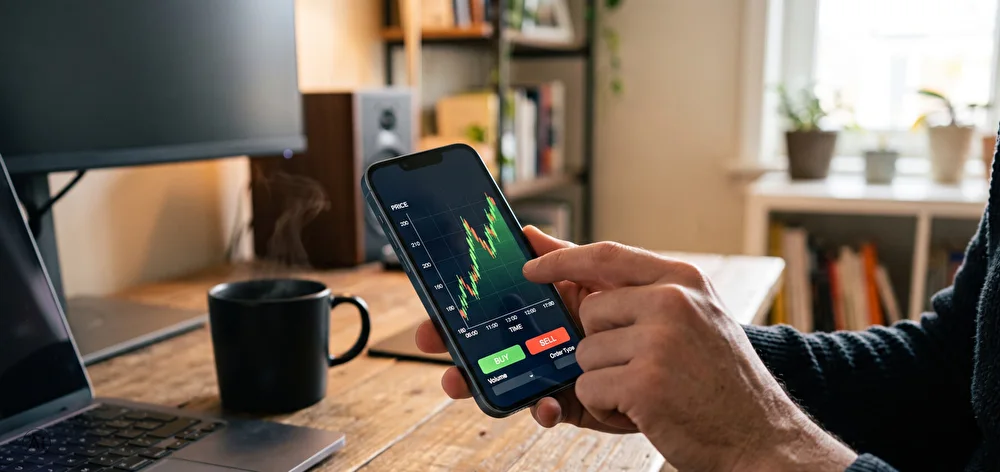
Whether stocks, bonds, or ETFs, numerous Swiss invest their money in securities. But the fees they pay to their bank for brokering the trade can be extremely high, as a moneyland.ch analysis shows. Using a low-cost stockbroker can save you a lot of money.
A growing number of Swiss invest their money in the stock market. That is no surprise considering that the stock markets long term performance. While stock investments do not have guarantees against loss, over the long term they have consistently outperformed more conservative investment vehicles like savings accounts. But investors should pay attention to fees charged by stockbrokers, as these can substantially reduce your returns.
The only comparison service moneyland.ch analyzed the fees charged by the most important Swiss conventional banks and online trading platforms. The study reveals wide differences in costs between different stockbrokers. For the analysis, moneyland.ch calculated the costs for three different profiles: passive portfolio, occasional trader, and frequent trader. The profiles are explained in detail in the methodology box.
“It is important to understand that depending on how you invest, the actual fees can vary from those shown here,” remarks moneyland.ch editor Dan Urner. It is beneficial to compare stockbrokers based on your individual investment needs.
The most important costs to pay attention to
Most of the costs generated by investing are directly related to which stockbroker you use. The most important fees charged by stockbrokers are custody fees and brokerage fees for buying or selling assets, and recurring custody fees and account fees. The currency exchange fees are also worth paying attention to. Some stockbrokers pass on stock exchange fees to investors, but these are generally a relatively small cost. No matter which Swiss stockbroker you use, you will always be charged the government stamp duties for trades.
The moneyland.ch analysis accounts for custody and accounts fees, as well as brokerage fees and stamp duties, for a period of one year. The calculations are based on specific portfolio values, and on trades made on specific stock exchanges (refer to the methodology box). The analysis does not account for third-party costs such as the total expense ratios (TERs) of funds and structured products. The comparison is based on the fees that apply when all interaction is made through the online portal, and does not account for phone-based orders.
Profile 1: The cheapest Swiss stockbrokers for a passive portfolio
Not all investors actively buy and sell securities. Many simply want to hold their existing portfolio. The passive portfolio profile does not account for any buy or sell trades, but only the fees applicable to holding an existing stock portfolio worth 45,000 francs.
The leading stockbroker for this profile is Saxo Bank, which does not charge any custody fees or basic account fees. For the passive portfolio profile, Saxo Bank does not have any costs at all. The only possible costs are third-party fees, such as the total expense ratios charged by fund or structured product operators. The second and third places are taken by Trade Direct (48.60 francs) and Postfinance (72 francs).
Profile 2: The cheapest Swiss stockbrokers for occasional traders
The occasional trader profile assumes a portfolio worth around 45,000 francs, and a total of 12 trades per year.
Here too, Saxo Bank takes the first place by a wide margin, with costs of 68.30 francs. Next in line are Cornèrtrader (245.35 francs) and Postfinance (345.45 francs).
Profile 3: The cheapest Swiss stockbrokers for frequent traders
For the frequent trader profile, moneyland.ch assumes a portfolio worth around 75,000 francs, and a total of 70 trades per year.
Here too, Saxo Bank is the clear leader, with costs of 748.20 francs. It is followed by Cornèrtrader (245.35 francs) and Postfinance (345.45 francs) in second and third place.
Neobanks as an alternative
Some Swiss neobanks also provide stock and ETF investment services. These are particularly attractive for small investors, for whom they can be very affordable. “For larger investments, using a specialized stockbroker can cost less. It is also important to note that neobanks have more limited selections of securities and services,” explains Dan Urner.
Neobanks are also poorly suited for investors who prefer to trade on a desktop, as most of them only provide services through a mobile app. You can find more information in the moneyland.ch guide to investing with neobanks. Get a detailed overview of the Swiss trading study 2026 sent to your email free of charge.
Swiss trading study 2026
Methodology
moneyland.ch compared the fees for buying and selling securities, and custody fees for holding securities, across leading Swiss banks. The comparison also accounted for possible account fees, and for government stamp taxes. The analysis only accounts for the fees charged for transactions initiated via online trading portals. Possible stock exchange fees are not accounted for, but these fees are generally very low. Calculations are based on the use of these stock exchanges: Nasdaq, NYSE, or AMEX for US securities (in US dollars)). SIX Swiss exchange for Swiss securities (in Swiss francs). Xetra for European securities (in Euros). Currency exchange costs could not be accounted for due to insufficient information. The analysis does not account for special promotions or for foreign stockbrokers.
The following stockbrokers are included in the comparison: Aargauische Kantonalbank, Bank Cler, Basler Kantonalbank, Berner Kantonalbank, Cash – Banking by Bank Zweiplus, Cornèrtrader, Migros Bank, Postfinance, Raiffeisen, St. Galler Kantonalbank, Swissquote, Trade Direct (BCV), UBS, VZ Ticket Fee Online (Vermögenszentrum), Zürcher Kantonalbank. The analysis is based strictly on execution-only offers, without investment advisory.
For the comparison, moneyland.ch calculated costs based on three profile: Passive portfolio, occasional trader, and frequent trader. These profiles are based on standardized portfolios made up of Swiss stocks, Swiss ETFs, European stocks, and US stocks.
Passive portfolio profile: An existing portfolio consisting of: 15,000 francs worth of Swiss stocks; 7500 francs worth of Swiss ETFs; 12,500 euros worth of European stocks; 14,000 US dollars worth of US stocks. This profile does not include any buy or sell trades.
Occasional trader profile: A portfolio made up of: 15,000 francs worth of Swiss stocks; 7500 francs worth of Swiss ETFs; 12,500 euros worth of European stocks; 14,000 US dollars worth of US stocks. The profile also includes these trades: Four trades of Swiss stocks, with each trade worth 3000 francs; two trades of Swiss ETFs, with each trade worth 3000 francs; three trades of European stocks, with each trade worth 3000 euros; three trades of US stocks, with each trade worth 3000 US dollars.
Frequent trader profile: A portfolio made up of: 25,000 francs worth of Swiss stocks; 12,500 francs worth of Swiss ETFs; 21,000 euros worth of European stocks; 23,500 US dollars worth of US stocks. The profile also includes these trades: 20 trades of Swiss stocks, with each trade worth 6000 francs; 10 trades of Swiss ETFs, with each trade worth 6000 francs; 20 trades of European stocks, with each trade worth 6000 euros; 20 trades of US stocks, with each trade worth 6000 US dollars.

Current Offers From Banks
Current Offers From Banks
Swissquote
Leading Swiss online bank with FINMA license
Free multicurrency account & low commissions
Access to more than 3 million products (shares, ETFs, crypto and more)
Discretionary Mandate
Up to CHF 100 welcome bonus
Customized portfolios & unlimited access to wealth advisor
Daily rebalancing
Swisscard Cashback Cards Amex
No annual fees
Two cards Amex & Visa/Mastercard
With cash back
UBS Banking for adults
Open and manage your account, savings account, and cards easily in the UBS Mobile Banking App
Plus KeyClub rewards program
50 CHF welcome gift
UBS Gold Credit Card
High card limit for more flexibility
Premium travel insurance included
Earn valuable KeyClub points with every payment
 Deal of the Day
  Swiss Trading Platform
Swissquote
Leading Swiss online bank with FINMA license
Current Offers
Current Offers
Discretionary Mandate
Up to CHF 100 welcome bonus
Customized portfolios & unlimited access to wealth advisor
Daily rebalancing
Swisscard Cashback Cards Amex
No annual fees
Two cards Amex & Visa/Mastercard
With cash back
Swissquote
Leading Swiss online bank with FINMA license
Free multicurrency account & low commissions
Access to more than 3 million products (shares, ETFs, crypto and more)
PKZ Insider Card Visa
Welcome Bonus of CHF 100
No annual fees forever
Double bonus with PKZ and up to 1% worldwide
UBS Banking for adults
Open and manage your account, savings account, and cards easily in the UBS Mobile Banking App
Plus KeyClub rewards program
50 CHF welcome gift


 protected by