An overview: The most important financial planning tips from the BKB experts
- Start building your Pillar 3a early: Open a retirement account, pay into your pillar 3a regularly, and profit from the compounding interest effect – even with small amounts (e.g. 50 francs per month).
- Close gaps in your retirement savings: To avoid lifelong pension reductions, have your OASI individual account (IA) and your occupational pension fund statements reviewed on a regular basis.
- Plan for retirement from age 50: Get professional financial planning to check your possibilities for optimization and arrange your finances based on your preferred retirement age
- Arrange your estate: Estate planning lets you deal with topics like living wills, your will and testament, contracts of succession, and others in order to use legal minimum inheritance shares in an optimal way, and avoid conflicts between your heirs.
The BKB podcast «Vorsorge hoch drei»
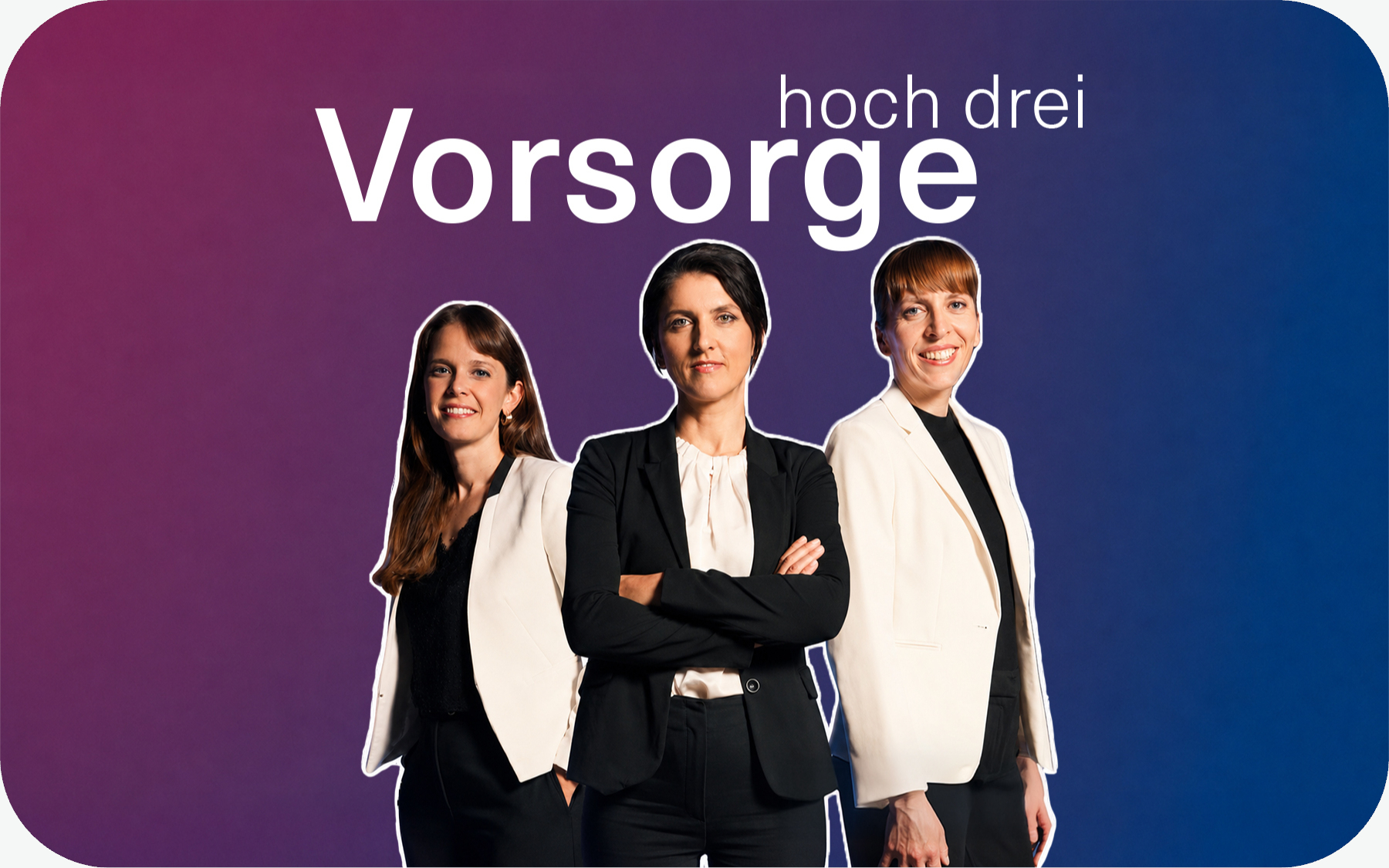
The Basler Kantonalbank’s podcast for more clarity about retirement and financial planning, with:
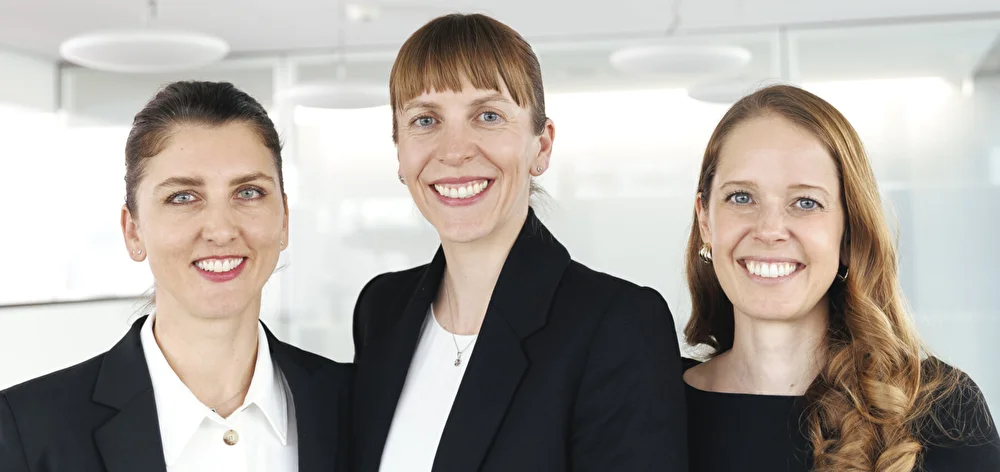
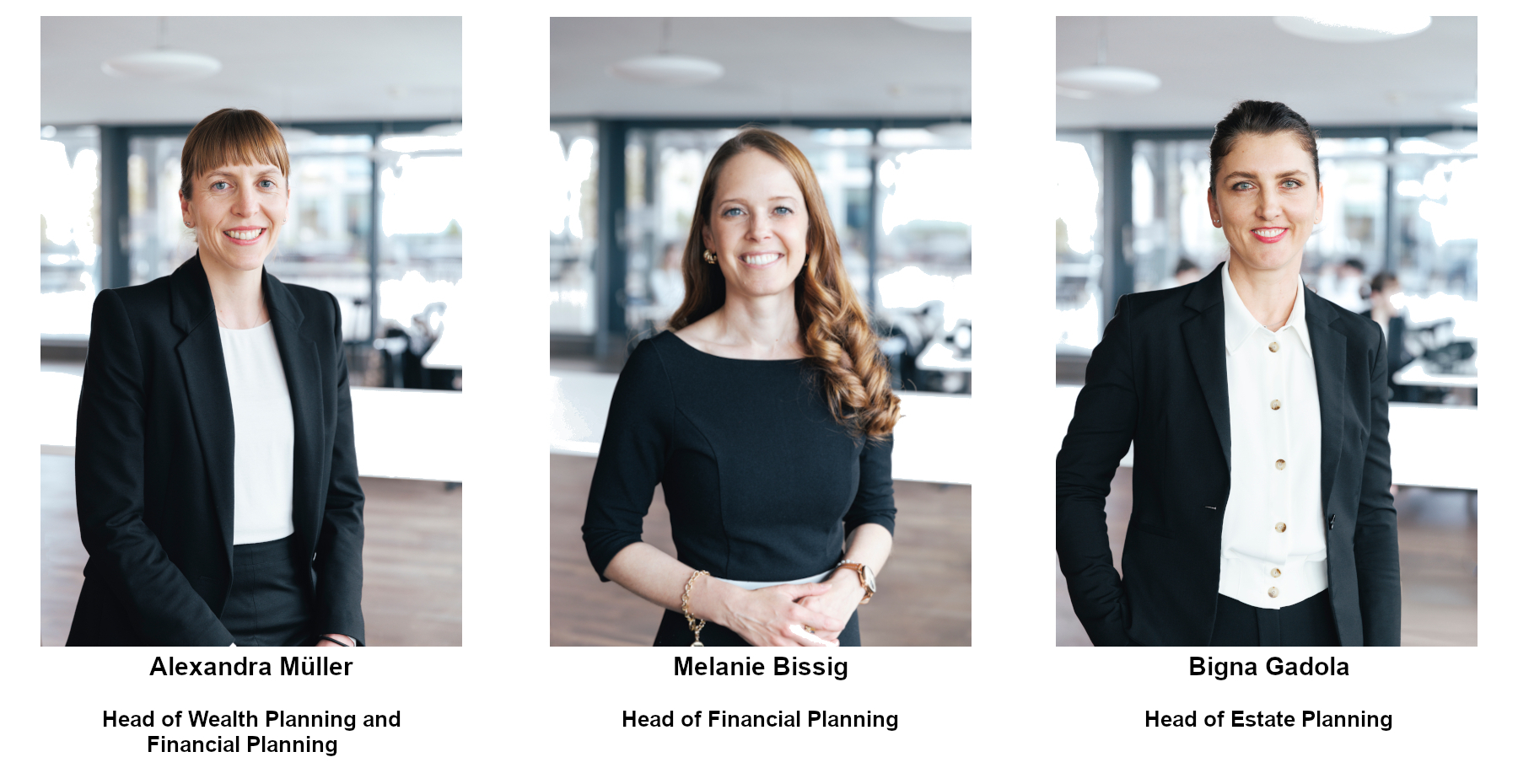
- Alexandra Müller, head of wealth and retirement planning, BKB
- Melanie Bissig, head of financial planning, BKB
- Bigna Gadola, head of estate planning, BKB
Because financial planning doesn’t have to be complicated:
Watch or listen to the podcast now
Ralf Beyeler: Bigna, Melanie, and Alexandra, as financial planning experts, your recently-launched “Vorsorge hoch drei” podcast helps to clarify topics like retirement, financial planning, and estate planning. How has the feedback been so far?
Alexandra Müller: The relatable language, the short episodes, and the implementable tips have been very well received. Many listeners have come to realize that even simple steps already make a difference. For example, we received a broad reaction in relation to OASI individual account statements. Many people wanted to know how to recognize and close gaps in their OASI pensions.
Melanie Bissig: Exactly. Some of these people then requested an OASI statement for the first time in their life. Many now also have more confidence in relation to stock investments and the pillar 3a.
Ralf Beyeler: How are you experiencing your new role as podcast hosts?
Bigna Gadola: In spite of our experience with customer functions and television, we still had to find our way. Even a casual conversation needs clear guidelines to ensure that the most important information is dealt with.
Ralf Beyeler: Which exactly is dealt with in retirement planning, financial planning, and estate planning?
Melanie Bissig: Retirement planning and financial planning involved analyzing your current and prospective income, expenses, and assets from today up until long after retirement. Together, we answer questions like “Will I be able to maintain my living standard after retirement?” “How should I, as an employee or self-employed person, best go about providing for my future?” “How can I lower my tax bills up until retirement?” There are different ways to go about retiring, and each one has its own financial consequences. That is why we create a customized, chronological roadmap for implementing your personal retirement plan.
Bigna Gadola: Estate planning looks at key points like: How high are minimum inheritance shares? Who will inherit what, and do I need an inheritance contract? Who will make important decisions for me if an illness or accident makes it impossible for me to make decisions myself? Who will execute my will? There is often a lot of room for adapting your estate above what is required by law. Planning ahead lets you make these important decisions yourself.
Alexandra Müller: As the head of wealth and retirement planning, I am responsible for both of these areas. We explain the increasingly complex retirement jungle in a clear way, and help you to implement a plan so that you can be best prepared for the future.
Ralf Beyeler: The pillar 3a is an important part of financial planning. Are there any questions about it that you hear especially often?
Melanie Bissig: Many people do not know that they can still pay into the pillar 3a in the year that they retire. Many do not know that they do not need to cash out all pillar 3a accounts immediately if they retire early, but can space withdrawals out up to the standard retirement age of 65. A question common among people who are both employed and self-employed is: Can they contribute up to the higher limit or the lower limit, or both? Many people also wonder how long they can continue paying into the pillar 3a if they continue working after retirement age. The answer to that question is: They can contribute up to the age of 70, as long as they earn an income that is subject to OASI contributions.
Ralf Beyeler: The selection of pillar 3a solutions continues to grow, partly because of new digital service providers. What does the Basler Kantonalbank offer?
Alexandra Müller: It is always important to look at the quality of a service. Cheap does not automatically translate into good. The Basler Kantonalbank offers solid investment and retirement saving solutions like its pillar 3a savings account, the pillar 3a investment solutions, personal consultation, and long-term support in person. That level of presence is particularly helpful in key stages in life like marriage, starting a family, buying real estate, retiring, or passing on your business. We can provide real support at the latest by the time these events occur, though planning with us ahead of time is ideal.
Ralf Beyeler: Speaking about planning ahead of time, what advice would you give to young people who are just starting their career?
Melanie Bissig: The first thing to think about is: How much can I save, and do I want to invest in stocks and other securities? It makes financial sense to use the pillar 3a for those things. You do not have to make the maximum pillar 3a contribution right from the start. Every franc counts. If you were to always make the maximum contribution and invest it with a large stock component from the age of 20 to the age of 65, you could accumulate a projected 1.9 million francs by retirement. If you calculate using the contribution limit applicable from 2027, the amount would be 2.1 million francs. That shows the power of compounding returns. Money you can save on top of that can go towards goals like saving for a trip or investing. A trusted person or a customer advisor you trust can help you find a solution suited to your needs.
Ralf Beyeler: Starting a family often leads to reduced working hours and less saving for retirement.
Alexandra Müller: Bigna and I know that from personal experience. When a person – in many cases a mother – reduces their work hours, it often creates gaps in their retirement plan. But even so then, there is sometimes extra money left over. If you were to place just 50 francs per month in a savings plan with the highest stock component, you could save up around 20,000 francs for your child by the time they turn 18. In this case, it is investing the money that makes the difference.
Bigna Gadola: My ex-husband and I discussed our finances back then before our daughter was born. When it comes to the pillar 3a, transparency and equality pay off. I know couples where only the man continued to contribute. But savings for retirement is absolutely essential for women. Without a retirement plan, you could end up with financial gaps due to things like reduced work hours, the gender pension gap, lack of cover for unmarried partners, and so on. Couples who decide together that they want to have children should, in my opinion, both contribute the same amount – even if it is only 50 or 100 francs per month. The birth of your first child is also a good time to get informed about guardianship provisions, advanced healthcare directives and other living wills, and your will and testament – and to create these.
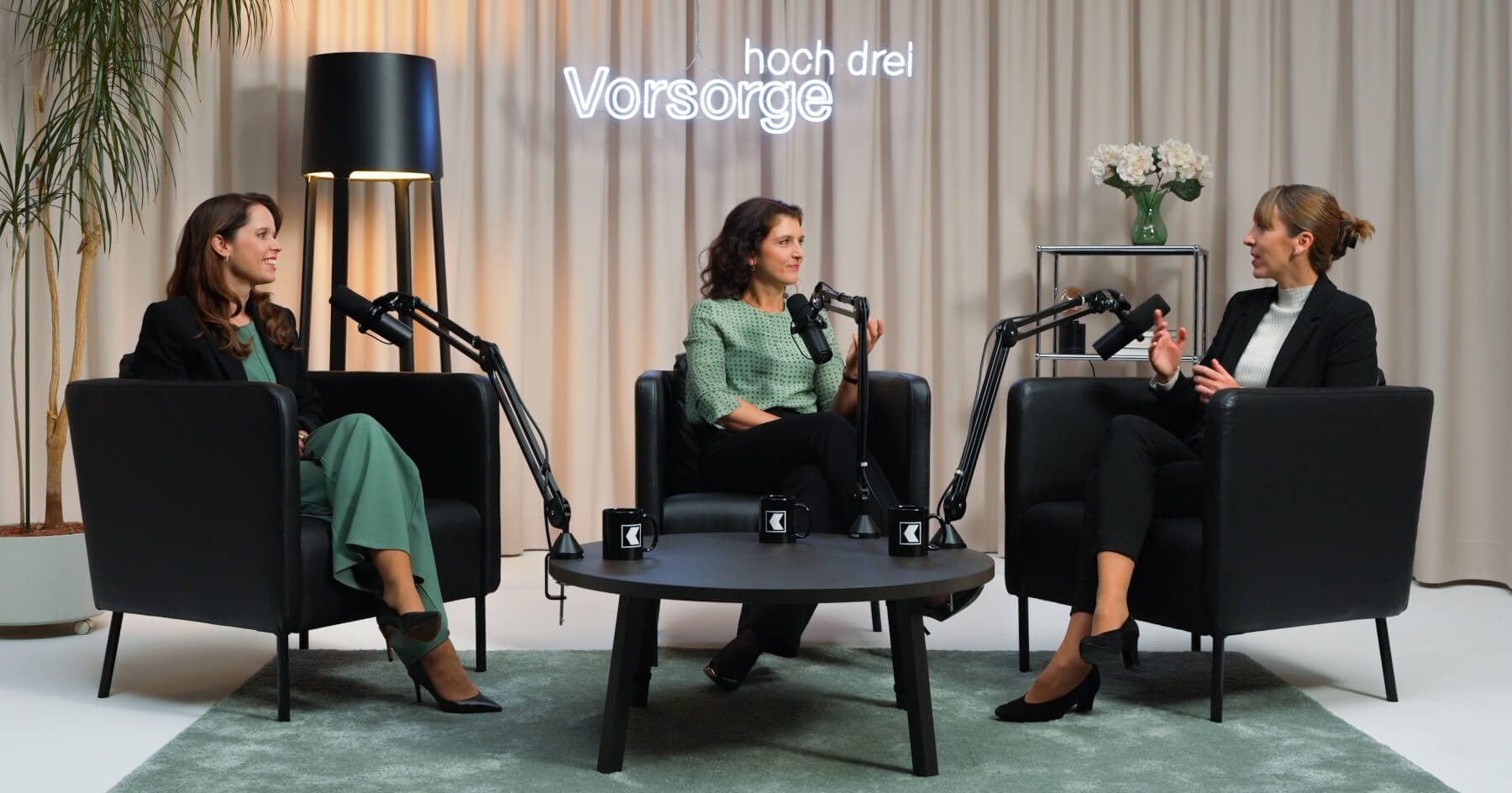
Image: Scene from an episode of the BKB podcast “Vorsorge hoch drei” showing, from left to right: Melanie Bissig (Head of Financial Planning, BKB), Bigna Gadola (Head of Estate Planning, BKB), and Alexandra Müller (Head of Wealth and Retirement Planning, BKB)
Ralf Beyeler: And when should I think about planning my estate if I do not have children?
Bigna Gadola: Sooner rather than later. For many people, their own death is an emotionally-sensitive topic. But it helps to adapt your perspective: You are doing it for those you love, so that they will be protected financially and will not have unnecessary conflicts. Those who do not have children may still want to provide for their partner, relatives, or other people close to them.
Ralf Beyeler: Do people tend to wait too long before planning their estate?
Bigna Gadola: Definitely. For many people, finally making an estate plan lifts a huge burden from their shoulders. In the words of one customer “It is so liberating – and I will not die any sooner because I took care of it now.” It is also important for families and homeowners to ask themselves: Does my child want to take over my home? Would I be willing to transfer ownership to them while I am still alive? Possible inheritance advances are also part of estate planning.
Ralf Beyeler: What are common causes of inheritance disputes?
Bigna Gadola: The most common cause of inheritance-related conflicts are inheritance advances made long before. After the death of their parents, a sibling claims that “My brother got 50,000 francs 30 years ago, and I did not.” That is why we often invite the children to estate planning sessions as well. If conflicts do still arise, our experts provide professional mediation to find solutions that suit all of the involved parties without the time and expense of a court case.
Ralf Beyeler: At the age of 50, retirement no longer seems so far away. What are the important financial considerations in this stage of life?
Melanie Bissig: From the age of 50, people begin to ask themselves: When would I like to retire? Will I have enough income later on in life? Could I retire early? Should I choose a pension or lump-sum withdrawal from my pension fund – or both? How can I optimize my taxes? Will I continue to meet the affordability requirements for my mortgage after I retire? You may be able to improve your retirement situation by closing gaps in your occupational pension fund and pillar 3a. Financial and retirement planning creates clarity and gives you options for making adjustments early on.
Ralf Beyeler: What does the recently published BKB retirement study “Glücklich älter werden” show us?
Alexandra Müller: The BKB retirement planning study clearly shows that private retirement saving is gaining importance. In 2007, just under one-third of employees in Basel used the pillar 3a. By 2022, the figure had climbed to 46 percent. But four out of 10 people between 50 and 64 years old do not have a clear retirement plan. Still, more than half or pensioners in Basel are happier than they were before retiring. They have more time for family, friends, and hobbies, and more freedoms. But the level of satisfaction is heavily correlated with finances. Those who prepare for retirement early on have an advantage.
Ralf Beyeler: How is Basel different from other Swiss cities – also with regards to retirement consultation?
Alexandra Müller: Basel is globally minded while also being deeply rooted in the region. It combines a global melting pot, a lively arts and culture scene, and a strong sense of community. That diversity is tangible in our work as well: Our customers differ greatly in terms of their backgrounds and the financial questions they have. That means our consultation too is broader and more complicated than elsewhere. The reason for that is: As an international pharmaceutical and chemicals hotspot, the city on the border triangle draws many well-educated specialists from abroad. Resultantly, English is frequently used in our consultations on topics like retirement planning, companies and SMEs, and estate planning.
Melanie Bissig: From the standpoint of retirement, financial, and succession planning, Basel is one of the most interesting cities in Switzerland. Basel is for us financial planners what Zurich is to IT specialists. Company succession planning, for example, is one area in which a lot of work is required. Out of the 163 surveyed companies in Northwestern Switzerland, 61 did not yet have solutions for financing the transfer of ownership. That was shown by this year’s study on SME business succession planning in Northwestern Switzerland carried out by the Basler Kantonalbank.
Bigna Gadola: In addition to those things, there is also Basel’s strong culture of foundations and philanthropy. With 45 foundations per 10,000 residents, Basel-Stadt has the highest concentration of foundations out of all of Switzerland’s cantons. Making gifts to foundations or establishing a new foundation are important topics for many of our customers, especially in wealth management.
Ralf Beyeler: What is your financial plan? Do you have any personal retirement planning tips?
Alexandra Müller: Hard to believe, but true: I sometimes neglect my own retirement planning (laughs). I use standing orders to invest in both regular and pillar 3a savings in the stock market. I find it important to have a freely-available financial buffer. Still on my to-do list: Update my advance care directive and my will and testament with Bigna. When my existing documents were created, my son was not even born yet.
Melanie Bissig: I pay into a 3a solution with a large stock component on a monthly basis. Using multiple pillar 3a accounts will enable me to optimize my taxes by staggering withdrawals. I also invest in stocks – at 38 years old, I still have a long investment horizon. When it comes to estate planning, Bigna has been a very competent advisor.
Bigna Gadola: I have been investing my pillar 3a savings in the stock market for seven or eight years now, and I am very satisfied with the results. For estate planning, I have always adapted my documents to match current life events. My daughter will be 10 soon – meaning the guardianship provision is no longer completely necessary. I have revised my advance care directive several times already. I have not yet created a will and testament because the standard rules by which my daughter is my sole heir work fine for me.
Financial preparedness begins with a plan
Do you have a financial plan? We can analyse your financial situation and create a strategy that is tailored to your specific needs. Contact us today to make an appointment for personal consultation.
Get personal consultation
Open a pillar 3a account online
About the Basler Kantonalbank
The Basler Kantonalbank (BKB) is the leading universal bank in the Basel region. With a legal mandate from the canton of Basel-Stadt, the bank has been bonded to the region since 1899, and works towards creating a high quality of life in the Basel. It offers private individuals, business customers, wealth management customers, and institutional investors a full range of financial services – and comprehensive investment and financial planning consultation in particular. With around 100 wealth management experts, the Basler Kantonalbank is able to provide 360-degree consultation to customers with complex financial situations.
BKB: The financial planning bank for Basel and Northwestern Switzerland
As a financial planning specialist in Basel and Northwestern Switzerland, the Basler Kantonalbank supports both private individuals and SMEs with their financial planning and succession planning. It offers comprehensive consultation covering wealth and financial planning, retirement, estate planning, taxes, and more.
More on the topic of financial planning: