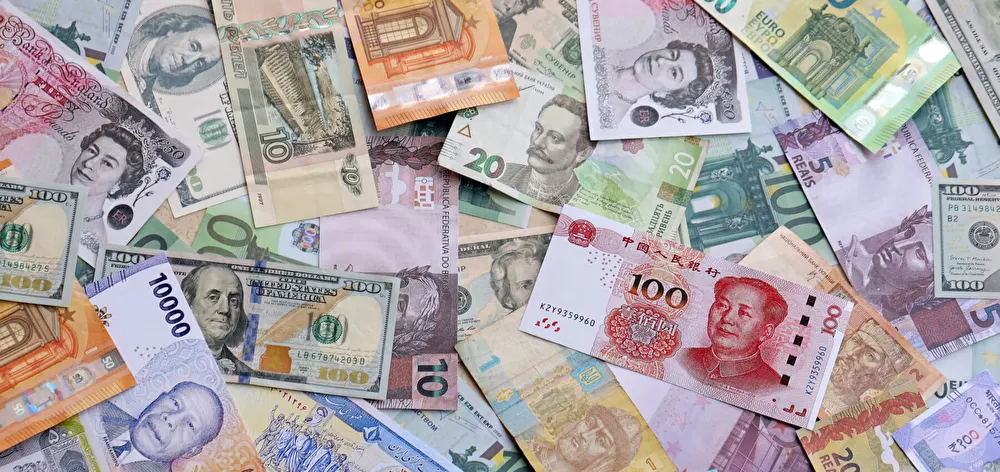
From US dollars, to euros, pound sterling, or yen: many investors see fiat currencies as an attractive investment opportunity. There is also the fact that the foreign exchange (forex) market is the biggest financial market in the world. This moneyland.ch guide provides the most important information about investing in currencies.
What makes foreign currencies interesting for investors?
The values of currencies are constantly changing. If the price of a currency you buy and hold goes up, you can potentially earn high returns. This has made foreign currencies a beloved vehicle for speculative investing. But apart from gambling on currency exchange rates, there are also other possible reasons for investing in forex:
- Fast returns: Investors who buy and sell currencies – often referred to as traders – hope to achieve fast returns. Currency exchange rates are constantly fluctuating. Leveraged products can be used to quickly earn high returns when the prices develop in your favor, but also amplify losses when the market goes against you.
- Diversification: Foreign currencies can be used as an asset class to diversify your investment portfolio. Holding foreign currencies is also a way of hedging against the risk of your home currency losing value. It is worth noting though, that the Swiss franc has historically been exceptionally stable.
- High interest rates: Each currency has its own key interest rate. This key rate affects the interest rates of bank accounts and bonds denominated in that currency. If interest rates for accounts and bonds in a certain currency are exceptionally high compared to your own, the interest earned can make it profitable to hold that currency.
Foreign currency accounts and sub-accounts
If you frequently send money to people in other countries, or travel to certain countries often, it can be beneficial to hold some reserves of the needed currencies. That can be done either by holding physical currency, or by using foreign-currency-denominated bank accounts. There are also some neobanks like Yuh, Revolut, and Wise, that let you create sub-accounts for different currencies.
Which factors affect currency exchange rates?
In principle, the value of a currency is determined by supply and demand. But there are a number of factors that affect the supply of a currency and demand for that currency. These factors, in turn, are directly linked to each other.
- Interest rates: Changes to key interest rates and other regulatory interventions by central banks – the Swiss National Bank (SNB), for example – have a direct impact on currency markets. A higher key interest rate tends to make a currency more attractive as an investment.
- Inflation rates: A high inflation rate reduces a currency’s buying power, which tends to result in that currency losing value in forex markets. A low inflation rate, on the other hand, can drive the price of a currency upwards.
- Geopolitical events: An unstable global political environment commonly results in increased demand for currencies that are seen as crises-resistant, which pushes up their price. The Swiss franc is one of these currencies.
- Politics: A stable political and economic framework engenders trust in a currency and attracts foreign capital, which increases demand.
- Predictions: Investor expectations for the political and economic future of a country also factor into the price of the currency used in that country or region.
How can I invest in foreign currencies?
There are several different ways to invest in fiat currencies. Which of these is best for you depends on your risk tolerance and experience, as well as your investment goals. Ways to invest in foreign currencies include:
- Physical currency: You can buy foreign currencies physically in the form of banknotes at many Swiss banks.
- Foreign currency sub-accounts: Many neobanks give you the option of creating sub-accounts denominated in foreign currencies. Examples include the Swiss neobank Yuh, and foreign neobanks Revolut and Wise.
- Foreign currency bank accounts: Many Swiss banks offer bank accounts that are denominated in a foreign currency. Accounts in euros and US dollars are the most widely offered.
- Forex trading: In forex trading, you take advantage of short-term fluctuations between a pair of currencies. Using leverage greatly amplifies the potential returns, as well as the potential losses.
- Securities denominated in foreign currencies: You can invest in foreign currency by buying shares in money market funds or ETFs. Buying bonds denominated in foreign currencies is another way to indirectly invest in forex. The situation is different with foreign stocks and stock market funds or ETFs: While the currency in which they are listed does affect your overall investment, the value of stocks themselves is primarily determined by other factors.
Foreign currencies in global ETFs
ETFs that replicate globally-diversified world stock market indexes hold a diverse selection of stocks listed in many different currencies. Swiss stocks make up only around two percent of the MSCI World, while other approximately 98 percent are listed in foreign currencies. Stocks listed in US dollars make up nearly 70 percent of the index (as per November 2025). But in spite of this currency risk, global indexes are still generally considered to be a good basis for a broadly diversified portfolio. You can increase the franc-denominated part of your portfolio by additional investments in Swiss stocks.
How does forex trading work?
The forex market trades nonstop between Sunday evening and Friday evening. Much of the trading is done over the counter (OTC), outside of official currency exchanges. With a daily trade volume of 7.5 trillion US dollars, the currency market is the world’s biggest financial market (as per 2022). The three most traded currencies are the US dollar, the euro, and the Japanese yen (as per 2025).
A forex trade is always based on a pair of currencies – the euro and the Swiss franc, for example. The first currency shown in a currency pair is called the base currency. The second is called the quote currency or counter currency. The trade is always based on the price of the base currency in relation to the price of the quote currency. The euro-US dollar currency pair is the most-traded currency pair in the forex market.
If you expect the base currency (the Swiss franc, for example) to gain in value, then you would open a long position. This means you buy the base currency and sell the counter currency. If, on the other hand, you predict that the base currency will become cheaper in the counter currency, then you sell the base currency and buy the counter currency.
Forex trading is most widely used for short-term speculation, such as intraday trading. Because the daily fluctuations between two currencies are usually very small, many investors use leverage to amplify the changes by a certain factor. This increases both the potential returns and the potential losses by the chosen factor. Contracts for difference (CFDs) are one example of a leveraged product.
Find the most affordable trading platform
Leveraged forex trading requires a trading platform. The banks that operate these platforms charge fees in the form of a spread – a markup added to the price you pay to buy a currency, and a markdown taken off the price you get when you sell the currency. Markups and markdowns on the rollover interest charged or earned when you hold forex positions longer than a day add another expense. Some banks also charge brokerage fees or commissions.
If you want to trade foreign currencies, it is important to avoid high fees, as these eat away at your returns. Comparing different forex trading service providers before you start investing is advisable. You can get an overview of Swiss banks that offer forex trading using the moneyland.ch stockbroker comparison. Just select the forex filter under “Specialized asset types” to limit comparison results.
Even if you do not use leverage forex trading, and simply hold foreign currencies in bank accounts or sub-accounts, you should still keep an eye on possible fees and charges. In addition to possible account fees, you should also look at the rates used for currency conversions.
What are the disadvantages and risks of investing in foreign currencies?
Currency exchange rates are affected by numerous factors, and fluctuate incessantly. This creates a constant risk of loss, which is amplified if you use leverage. Inexperienced investors would do well to stay away from forex trading completely. That is especially true for highly-leveraged instruments like CFDs.
When are foreign currencies a suitable investment?
Because there are many different factors that affect currency exchange rates, price developments are very difficult to predict. Even experienced investors and financial professionals cannot accurately predict exchange rates ahead of time. Before you invest in foreign currencies, you should be aware of this unpredictability, and understand that the only sure thing is the high risk of loss.
The forex market is continuously changing, and currency exchange rates can shoot up or drop down sharply. Using leveraged products multiplies the risk of losing money. Leveraged investing is only advisable for experienced investors who understand the risks and can easily afford to lose the invested money.
But apart from investing, it can be beneficial to keep a supply of foreign currency if you frequently visit a certain country. Doing this can reduce your currency exchange costs and commissions for currency exchange. In this case, though, the currency is not held as an investment asset, per se. Additionally, some banks and neobanks now offer card-based payments with very low currency exchange markups and foreign transaction fees.
Note: This article is provided for informational purposes only, and should not be considered as investment advice. The publisher does not accept any liability in connection to this publication.
More on this topic:
Compare Swiss stockbrokers now
Cost pitfalls to watch out for in forex trading



 Deal of the Day