Mobile payments are popular in Switzerland. Many consumers use an iPhone or Apple Watch to settle payments for goods and services. Apple Pay is one of the most important mobile payment services.
This moneyland.ch guide answers the most important questions about Apple Pay.
1. How can I make payments using Apple Pay?
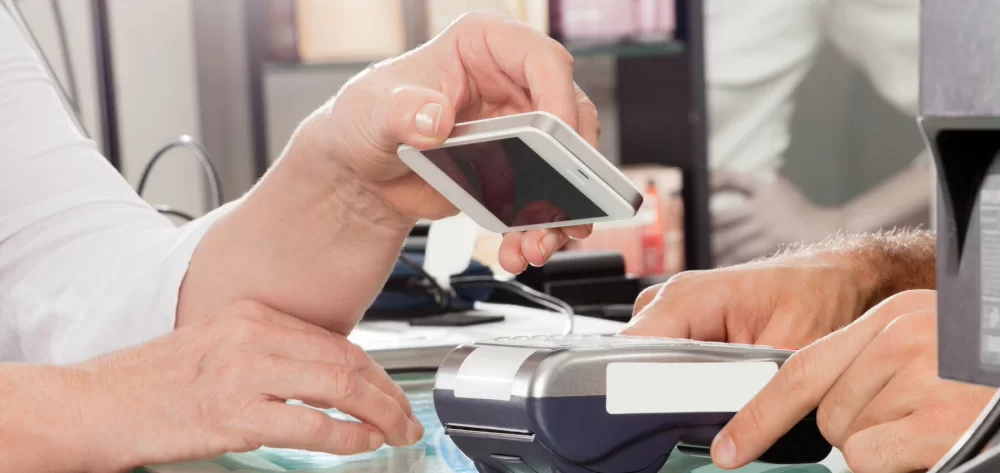
Apple Pay lets you make payments at POS terminals using an iPhone or an Apple Watch. This can be done without opening any app. You then authenticate the payment using face recognition, your fingerprint, or your password.
Apple Pay works with iPhones, iPads, Apple computers, and the Apple Watch.
2. Which payment cards can I use with Apple Pay?
Apple Pay works with all Swiss credit cards, and most Swiss debit cards. The card network – Visa, Mastercard, or American Express – is not important.
Whether or not a card works with Apple Pay depends on the card’s issuer. While Apple Pay is supported by all Swiss credit cards, there are some debit cards from Swiss banks that do not have Apple Pay support.
3. Where can I use Apple Pay for payments?
You can use Apple Pay to pay for purchases at numerous shops, restaurants, and Hotels in Switzerland and other European countries. You can also make payments in other regions, but you may encounter POS terminals that do not work with Apple Pay. As a general rule, POS terminals that can be used for contactless payments also work with Apple Pay.
Apple Pay can also be used to pay within iPhone and iPad apps, and at some online stores.
In every case, a payment with Apple Pay will only work if the merchant accepts the network of your linked payment card (Visa, Mastercard, American Express).
4. How much does using Apple Pay cost?
You do not pay any additional fees to use Apple Pay. The only fees you pay are those that apply to your linked credit card or debit card.
Knowing which fees your card has is especially important when you use Apple Pay outside of Switzerland. That is because you may be charged foreign transaction fees. Additionally, a poor currency exchange rate also results in higher costs. You can find more information in the guide to paying for purchases from foreign merchants. Debit cards may also have high fees for foreign currency transactions. Some Swiss credit cards have a foreign transaction fee of 1 or 1.50 francs per payment. If that is the case with the debit card you linked to Apple Pay, you should avoid using Apple Pay for small purchases.
5. Can I earn rewards when I spend with Apple Pay?
Whether or not you get rewards for your spending depends on if your linked credit card or debit card has a rewards program. If it does, then you will earn the same points, miles, or cash back whether you use Apple Pay or use your card to pay directly.
6. How secure is Apple Pay?
Contactless payments with Apple Pay are considered secure. For each payment you make, the POS terminal generates a unique security key that is sent to your card’s issuer. Additionally, Apple Pay requires payments to be authenticated by fingerprint, face recognition, or a password.
Like all payment methods, Apple Pay has certain vulnerabilities. For example, it is hypothetically possible that fraudsters steal your sensitive personal and card information and use it to create a fake Apple Pay account.
7. Does Apple Pay have sufficient privacy protection?
Apple stresses that it does not store information about financial transactions. However, your recent payment history is clearly shown in the wallet app. It is likely that Apple also has the capability to retrace the location and time at which transactions were made.
8. What are the advantages of using Apple Pay?
The interface is more user friendly than that of external mobile payment apps like Twint. That is not surprising, as Apple’s software is tightly integrated into its own hardware, and the company has built a reputation around usability.
For people who always carry their phone around, using Apple Pay can even be somewhat more user friendly than cards and cash, which require reaching for your wallet.
9. What are the disadvantages of Apple Pay?
The main disadvantage is that it only works on Apple devices. It is also worth noting that not all POS terminals are NFC-enabled.
From a privacy perspective, giving a tech giant access to information about your private financial life may be disturbing to some. That is not an issue when you use cash to pay.
How is Apple Pay different from Twint?
Twint can be used without having to link a credit card or debit card. It works on many different devices from numerous manufacturers.
The problem with external mobile payment services like Twint is that you have to open an app before you can pay. That is less convenient than fully-integrated solutions like Apple Pay.
10. Is Apple Pay popular in Switzerland?
According to a 2023 moneyland.ch survey, Apple Pay is still one of the less-widely-used payment methods. Only 24 percent of participants considered Apple Pay to be indispensable, compared to 78 percent for credit cards, and 79 percent for cash. Just 13 percent of survey participants actually use Apple Pay on a frequent basis.
More on this topic:
Compare Swiss credit cards now
Foreign transactions fees explained



 Deal of the Day